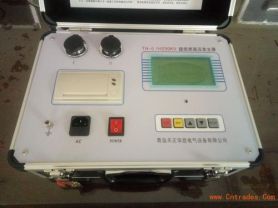


To help you write an article about the transformer partial discharge tester, I will provide a detailed outline that you can use to organize your article content.
Title
Transformer Partial Discharge Tester: A Key Tool for Ensuring Power System Safety
Introduction
Background: Briefly introduce the concept of partial discharge and its hazards to power equipment.
Importance: Emphasize the importance of transformer partial discharge testing, especially its impact on the safe operation of power systems.
Basics of Partial Discharge
Definition: Definition of partial discharge.
Causes: Reasons for partial discharge, including insulation aging, manufacturing defects, etc.
Effects: Long-term effects of partial discharge on transformers and other power equipment.
Working Principle of Transformer Partial Discharge Tester
Detection Principle: Explain how the tester detects partial discharge by detecting high-frequency pulse currents.
Main Components:
Sensor: Captures electromagnetic waves or acoustic waves generated by partial discharge.
Preamplifier: Amplifies the weak signals captured.
Filter Amplifier: Removes interference signals and extracts useful partial discharge signals.
Main Amplifier: Further amplifies the signal for subsequent processing.
Signal Processing: Describe the signal processing flow, including amplification, filtering, peak detection, etc.
Technical Specifications and Performance Indicators
Frequency Response Range: Describe the range of signal frequencies the tester can effectively detect.
Sensitivity: The ability of the tester to detect the smallest partial discharge signals.
Dynamic Range: The ability of the tester to distinguish between different intensities of partial discharge signals.
Anti-interference Capability: The ability to maintain accurate measurement in complex electromagnetic environments.
Data Output Methods: Introduce how data is recorded, displayed, or transmitted to a computer for further analysis.
Test Steps
Preparation: Pre-test checks and settings.
Connecting Equipment: How to correctly connect the tester to the transformer under test.
Operation Process:
Calibration: How to perform discharge quantity calibration.
Voltage Increase Test: Gradually increase voltage and observe partial discharge phenomena.
Data Acquisition: Record the characteristics of discharge pulses.
Analysis and Evaluation: How to interpret test results.
Application Cases
Transformer Testing: Real cases showing how it is applied to detect partial discharge in transformers.
Cable Testing: Describe specific application methods in cable testing.
Switchgear Testing: Introduce application scenarios in switchgear testing.
Usage Methods and Precautions
Installation Guide: Provide specific steps for sensor installation.
Operation Guide: List the basic operation procedures during use.
Safety Precautions: Emphasize safety matters to note during use, such as ensuring the equipment is tested at safe voltage levels, avoiding electric shock hazards, etc.
Maintenance: Provide recommendations for daily maintenance and care.
Technical Advantages and Limitations
Advantages: Discuss the benefits brought by the transformer partial discharge tester, such as improved detection efficiency, simultaneous multi-point testing, etc.
Limitations: Point out possible limiting factors, such as cost, operational complexity, etc.
Future Development Trends
Technological Innovation: Look forward to possible technological advancements, such as AI-assisted analysis, wireless remote monitoring, etc.
Industry Standards: Mention the development direction of relevant industry standards and regulations.
Conclusion
Summary: Review the importance and application prospects of the transformer partial discharge tester.
Call to Action: Encourage the power industry to adopt advanced detection technologies to enhance the safety and reliability of the power grid.
References
Academic Research: List relevant academic papers and research reports.
Industry Reports: Provide authoritative report links from the power industry.
Technical Manuals: Cite technical manuals provided by manufacturers.
Through the above structure, you can write a comprehensive article introducing the transformer partial discharge tester. Remember to incorporate the latest research findings and technological advancements when writing to ensure the content is accurate and up-to-date. If you need more specific information or technical details, feel free to ask me anytime.