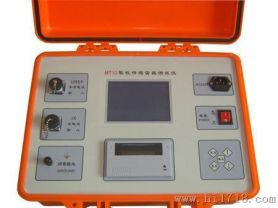

An ultrasonic partial discharge detector is a professional tool used for partial discharge detection in power equipment. It utilizes ultrasonic technology to capture partial discharge signals occurring inside power equipment. This article will detail the process of how an ultrasonic partial discharge detector converts captured ultrasonic signals into electrical signals, as well as the key technical points in this process.
1. Generation of Ultrasonic Signals
In power equipment, partial discharge phenomena may occur due to issues such as aging of insulating materials, cracks, and air gaps. Partial discharge generates high-frequency acoustic signals, which typically propagate in the air at frequencies above 20kHz, falling within the ultrasonic range.
2. Capturing Ultrasonic Signals
To capture these ultrasonic signals, an ultrasonic partial discharge detector is usually equipped with one or more ultrasonic sensors. These sensors can perceive ultrasonic signals within a specific frequency range and convert them into electrical signals.
3. Key Technologies in Signal Conversion
3.1 Ultrasonic Sensors
Ultrasonic sensors are the key components that convert captured ultrasonic signals into electrical signals. Common types of ultrasonic sensors include:
Piezoelectric crystals: When piezoelectric materials are subjected to mechanical stress, they generate voltage, and vice versa.
Electret diaphragms: Utilize polarized polymer diaphragms that generate electrical signals when subjected to ultrasonic vibrations.
Fiber optic sensors: Use light interference effects to detect changes in ultrasonic signals.
3.2 Signal Conditioning Circuits
Captured ultrasonic signals are typically weak and need to be amplified and filtered through signal conditioning circuits for subsequent analysis. The main components of a signal conditioning circuit include:
Preamplifier: Used to amplify the weak signals output by the sensor.
Filters: Remove unnecessary noise and retain effective signal frequency components.
Analog-to-Digital Converter (ADC): Converts analog signals to digital signals for computer processing.
4. Data Processing and Analysis
The conditioned electrical signals are sent to a data processing unit for further analysis. This typically includes:
Time-domain analysis: Displays the time characteristics of the signal, such as peak value, duration, etc.
Frequency spectrum analysis: Decomposes the signal into different frequency components, helping to identify specific types of partial discharge.
Trend analysis: Tracks the trend of signal changes over time to assess equipment health.
5. Alarm and Report Generation
Once abnormal partial discharge signals are detected, the ultrasonic partial discharge detector triggers an alarm mechanism to alert the operator. At the same time, the detection results can be recorded to generate detailed detection reports for subsequent analysis.
6. Conclusion
By converting captured ultrasonic signals into electrical signals and processing and analyzing them, ultrasonic partial discharge detectors provide important technical support for the maintenance of power equipment. This technology is crucial for preventing power equipment failures and ensuring the safe and stable operation of power systems. With continuous technological advancements, future ultrasonic partial discharge detectors will become more precise, intelligent, and user-friendly.