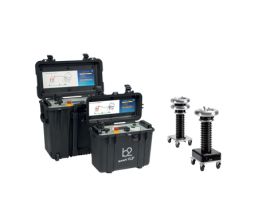

A single-channel partial discharge tester is an instrument specifically designed to detect partial discharge phenomena in power equipment. This type of tester is typically used to assess the insulation condition of high-voltage equipment, such as transformers, switchgear, and other high-voltage components. Below is an overview of an article about the single-channel partial discharge tester:
Single-Channel Partial Discharge Tester: Features and Applications
Partial discharge refers to a discharge phenomenon that occurs only in certain areas of the insulation system of power equipment when the applied voltage reaches a certain level. This discharge does not immediately cause the breakdown of the entire insulation system, but over the long term, it can damage insulation materials and eventually lead to equipment failure. Therefore, detecting and evaluating partial discharge is crucial for preventing failures in power equipment.
Features
The single-channel partial discharge tester has the following features
Strong anti-interference capability: Using digital filtering technology, it can effectively eliminate on-site interference, enabling accurate partial discharge measurements even in strong interference environments.
High sensitivity: It can detect very weak partial discharge signals.
Data accuracy: Advanced signal processing algorithms ensure the accuracy of measurement data.
Easy operation: It features an intuitive user interface that is easy to understand and operate.
Principle
The working principle of the single-channel partial discharge tester mainly includes the following aspects:
Signal acquisition: Sensors capture the pulse signals generated by partial discharge.
Signal processing: Analog and digital circuits are used to amplify, filter, and preprocess the collected signals.
Data analysis: Built-in algorithms analyze the processed signals to calculate partial discharge parameters, such as discharge magnitude and discharge count.
Result display: The analysis results are displayed to the user in graphical or numerical form.
Usage Method
Startup preparation: Adjust the time base mode of the tester to "ellipse".
Calibration: Correctly connect the calibration pulse generator, enable the calibration function, and ensure the accuracy of the tester.
Connecting the test circuit: After calibration, disconnect the calibration connection line, remove the calibration pulse generator, and then connect the tester to the high-voltage test circuit.
Adjust settings: Turn on the zero mark switch, slowly increase the test voltage until two zero mark pulses with a phase difference of 180 degrees appear on the display. Adjust the "ellipse rotation" so that the zero mark pulses are positioned at the upper left and lower right of the ellipse for easy observation.
Observing discharge: Continue to increase the voltage and observe the sustained discharge. When the discharge magnitude exceeds the specified low value, the voltage at this point is the partial discharge inception voltage.
Recording data: At the set voltage, when discharge pulse signals are observed, adjust the amplifier switch so that the height of the discharge pulses is between 0.2 and 2 centimeters. The discharge magnitude is then the reading on the digital meter multiplied or divided by 10.
Application Fields
The single-channel partial discharge tester is widely used in the power industry, especially in power plants, substations, and power equipment manufacturers. It can be used for:
Preventive maintenance: Regularly testing the insulation condition of power equipment to detect potential problems in a timely manner.
Quality control: Ensuring that the insulation performance of factory products meets standards during the production process of power equipment.
Fault diagnosis: Quickly locating and evaluating the causes of partial discharge in power equipment, helping maintenance personnel resolve issues promptly.
Conclusion
The single-channel partial discharge tester is an important detection tool for power equipment, and its accuracy and reliability are crucial for the safe operation of power systems. By regularly using such equipment for partial discharge detection, the reliability and service life of power equipment can be significantly improved.
The above content provides a basic overview of the single-channel partial discharge tester. Please note that different models and brands of products may vary in specific functions and usage details. In actual use, please refer to the operation manual of the specific equipment.