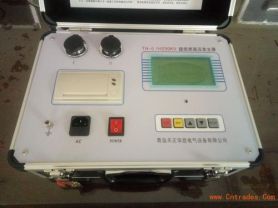


Transformer Capacity Characteristic Tester: Guardian of Precise Assessment in Power Systems Introduction
Writing an article about the transformer capacity characteristic tester, we can discuss its importance, working principle, usage methods, and application scope. Below is an overview article:
Transformer Capacity Characteristic Tester: Guardian of Precise Assessment in Power Systems
Introduction
In power systems, transformers serve as key electrical equipment responsible for voltage transformation and power transmission, and their performance directly affects the safe and stable operation of the power grid. The transformer capacity characteristic tester is a high-precision instrument used for on-site testing of transformer performance. It can accurately measure a series of important parameters such as transformer capacity, no-load loss, short-circuit loss, and impedance voltage, which is crucial for the maintenance and optimization of power systems.
Working Principle
The transformer capacity characteristic tester is designed based on the principle of electromagnetic mutual inductance. By detecting the voltage, current, and power of the transformer under specific conditions, it calculates the transformer's capacity and loss characteristics. The tester can automatically perform waveform distortion correction, temperature correction, and voltage/current correction to ensure accurate measurement results even under non-standard conditions.
Test Items
Capacity Measurement: Measures the actual capacity of the transformer to verify whether it conforms to the nameplate rating.
No-load Loss and No-load Current: Detects the energy loss and current of the transformer under no-load conditions, evaluating the transformer's efficiency.
Short-circuit Loss and Short-circuit Voltage: Determines the loss and voltage of the transformer under short-circuit conditions, reflecting the transformer's short-circuit strength.
Zero-sequence Impedance: Measures the transformer's response capability to unbalanced loads, used for analyzing fault currents in neutral grounding systems.
Usage Methods
The operation of the transformer capacity characteristic tester is usually very intuitive and has the following features:
Passive Measurement: No external power supply is needed; the transformer can be tested directly on-site.
Automation Function: Built-in algorithms automatically calculate corrected data, simplifying the operation process.
Data Recording: Can store a large amount of test data, facilitating subsequent analysis and report generation.
Rich Interfaces: Equipped with USB, RS232, and other interfaces, convenient for data export and remote control.
Application Scope
Power Systems: Regularly test the condition of power transformers to ensure the efficiency and safety of the power network.
Manufacturing: Test the quality of transformers during the production process to ensure the normal operation of equipment.
Research Institutions: Used for scientific research experiments to deeply explore the performance boundaries of transformers.
Maintenance and Fault Diagnosis: Quickly locate potential problems in transformers, reducing downtime.
Conclusion
The transformer capacity characteristic tester, with its high precision and multifunctionality, has become an indispensable tool in the power industry. By conducting detailed performance assessments of transformers, it not only ensures the stable operation of power systems but also effectively reduces energy consumption and extends equipment lifespan. With continuous technological advancement, the performance of such testers will further improve, making greater contributions to the sustainable development of the power industry.
This article summarizes the main functions, working principles, usage methods, and importance of the transformer capacity characteristic tester in power systems. I hope this information helps you understand this professional equipment more comprehensively.