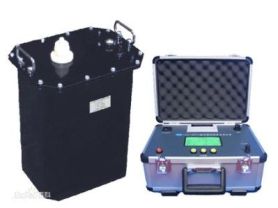
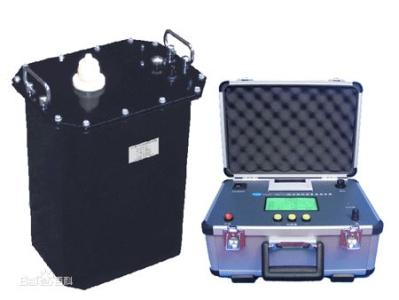
First-level Contracting Yonggao Power Ultra-low Frequency Insulation Withstand Voltage Test Device
Darui Electric recommends for you:
Principle of Ultra-low Frequency Insulation Withstand Voltage Test
The ultra-low frequency insulation withstand voltage test is actually an alternative method to the power frequency withstand voltage test.We know that when conducting power frequency withstand voltage tests on large generators, cables, and other test objects, due to their insulation layers exhibiting large capacitance, a test transformer or resonant transformer with a large capacity is required. Such huge equipment is not only bulky and expensive but also very inconvenient to use. To solve this contradiction, the power sector has adopted a method of reducing the test frequency, thereby reducing the capacity of the test power supply. Years of theory and practice at home and abroad have proven that using 0.1Hz ultra-low frequency withstand voltage testing instead of power frequency withstand voltage testing not only provides the same equivalence but also greatly reduces the size and weight of the equipment. Theoretically, the capacity is about one five-hundredth of that of power frequency, and it is simple to operate, offering more advantages compared to power frequency testing. This is why developed countries commonly adopt this method. The National Development and Reform Commission has formulated the industry standard "Test Method for Ultra-low Frequency (0.1Hz) Withstand Voltage of Cross-linked Polyethylene Insulated Power Cables up to 35kV and Below." Our country is promoting this method, and this instrument has been developed according to this national need. It can be widely used in AC withstand voltage tests for cables and large high-voltage rotating motors.
Product Introduction
This product integrates modern digital frequency conversion advanced technology, adopts microcomputer control, and fully automates voltage boosting, voltage reduction, measurement, and protection. Due to full electronization, it is small in size and light in weight, with a large-screen LCD display that is clear and intuitive, and can display output waveforms and print test reports. The design specifications fully comply with the power industry standard "General Technical Conditions for Special Test Instruments for Power Equipment, Part 4: General Technical Conditions for Ultra-low Frequency High Voltage Generators," and it is very convenient to use. Currently, both domestic and international methods use mechanical modulation and demodulation to generate ultra-low frequency signals, resulting in non-standard sine waveforms, large measurement errors, spark discharge in the high-voltage part, bulky equipment, and the need for high-power high-voltage resistors for discharge shaping in the second and fourth quadrants of the sine wave, resulting in high overall power consumption of the equipment. This product can overcome these shortcomings. In addition, it has the following features that need special explanation:
1.Current, voltage, and waveform data are all sampled directly from the high-voltage side, ensuring accurate data.
2.It has overvoltage protection. When the output exceeds the set voltage limit, the instrument will shut down for protection, with an action time of less than 20ms.
3.It has overcurrent protection: designed with dual protection for high and low voltage. The high-voltage side can perform precise shutdown protection according to the set value; when the current on the low-voltage side exceeds the rated current, shutdown protection will occur, with action times both less than 20ms.
4.The high-voltage output protection resistor is designed inside the boosting body, so no external protection resistor is needed.
5.Due to the adoption of a high-low voltage closed-loop negative feedback control circuit, there is no capacitive rise effect in the output.
Technical Parameters
1.Rated output voltage: see Table 1
2.Output frequency: 0.1Hz, 0.05Hz, 0.02Hz
3.Load capacity: 0.1Hz max 1.1µF
0.05Hz max 2.2µF
0.02Hz max 5.5µF
4.Measurement accuracy: 3%
5.Voltage positive and negative peak error: ≤3%
6.Voltage waveform distortion: ≤5%
7.Operating conditions: indoor and outdoor; temperature: -10℃~+40℃; humidity: ≤85% RH
8.Power fuse: see Table 1
9.Mains power: frequency 50Hz, voltage 220V±5%. If using a portable generator for power supply, the generator requirements: frequency 50Hz, voltage 220V±5%, power should be greater than 3KW, and a resistive load (such as an electric furnace) with a power of not less than 800W should be connected in parallel at the generator output to stabilize the generator's speed. Otherwise, the instrument will not work properly.
 Note: The above information and technical parameters are compiled and released by Yangzhou Darui Electric Co., Ltd.