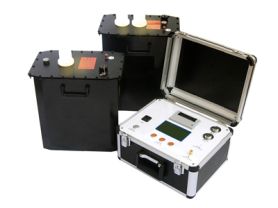

In power systems and industrial production, the resistance of electrical connection points directly affects the operational efficiency and safety of equipment. Excessive resistance can lead to heating, energy loss, and even equipment failure. As an efficient measurement tool, the DC resistance tester helps technicians accurately assess the resistance of conductors, ensuring the safe and stable operation of electrical equipment.
Working Principle of DC Resistance Tester
The DC resistance tester applies a constant DC current and measures the resulting voltage drop, calculating the resistance value according to Ohm's law. To improve measurement accuracy, the four-terminal method (Kelvin connection) is typically used, where the current source and voltage measurement probes are connected separately to eliminate the influence of lead resistance and contact resistance.
Main Features
High-precision measurement: Provides high-precision resistance measurement, typically within 0.01% accuracy.
Multiple range selection: Supports multiple range selections, suitable for resistance measurements in different ranges.
Four-terminal measurement: Uses the four-terminal method to eliminate the influence of lead resistance and improve measurement accuracy.
Automatic range switching: Automatically selects the appropriate range based on the resistance of the measured object, simplifying operation.
Data recording and analysis: Built-in memory can save a large amount of test data and analyze it through software.
Portable design: Some models are compact and easy to carry for on-site testing.
Test Steps
Preparation: Ensure that the tester and the device under test are in good working condition, and prepare the test leads.
Connect the test object: Use dedicated test leads to connect the object under test, ensuring a secure connection.
Set test parameters: Select the appropriate range and test mode based on the test object.
Start the test: Press the test button, and the tester automatically completes the measurement process.
Read the result: Read the resistance value on the tester's display and record it.
Data storage and analysis: Store the test data in the tester or export it to a computer via interfaces such as USB for further analysis.
Application Scenarios
Power system maintenance: Used to detect resistance at connection points in power equipment such as cables, busbars, and switchgear.
Motor and generator maintenance: Measure the resistance of motor windings to determine if there are open circuits or short circuits.
Transformer testing: Evaluate the resistance consistency of transformer windings to ensure normal operation.
Scientific research and teaching: Used to evaluate the performance of conductive materials in new material research and new product development.
Typical Cases
(Specific test cases can be inserted here, such as the process of a certain power equipment resistance test, problems found, and solutions)
Usage Precautions
Safe operation: When operating the tester, strictly follow safety regulations to avoid electric shock hazards.
Environmental impact: Pay attention to the temperature and humidity of the test environment to avoid affecting the accuracy of measurement results.
Clean connectors: Ensure that test connectors are clean and free of dirt to reduce measurement errors.
Regular calibration: Regularly calibrate the tester to maintain its measurement accuracy.
Conclusion
The DC resistance tester, due to its high precision and portability, has become a key technical tool for ensuring the reliability of electrical equipment. By regularly using this tester for inspections, faults caused by excessive resistance at connection points can be effectively prevented, ensuring the safe and stable operation of power systems.
Outlook
With technological development, future DC resistance testers will become more intelligent and automated, with stronger data processing capabilities and remote monitoring functions, further improving the efficiency and accuracy of electrical equipment testing.
This article outline provides readers with basic knowledge and application guidance about DC resistance testers. When writing a detailed article, more technical details and practical case analyses can be added based on specific situations.