With the continuous development of China's capital market, more and more enterprises are determined to raise funds through the capital market to continuously expand their business. The feasibility study report on the microcomputer relay protection calibration instrument fundraising project is a written report that assists enterprises planning to go public in completing the filing and approval of fundraising projects before IPO, and in coordinating with securities firms to provide necessary support for the company's prospectus. The design of the fundraising project should combine market segment reports and the company's own characteristics, reasonably predict the project's prospects and profitability, accurately describe the logical relationship with the company's core competitive advantages and sustained profitability, and demonstrate its feasibility, necessity, and controllability, fully aligning with the CSRC's review approach to ensure approval. Issues regarding the use of raised funds, whether there is a clear direction for the use of raised funds, whether the fundraising project has a clear profit prospect, lightning protection component tester. Whether the preparation for the use of over-raised funds is sufficient, and whether blind expansion will occur, etc. Among companies rejected for ChiNext IPO, organizational structure nearly half have issues with the use of raised funds, showing that the fundraising project is a critical part of the CSRC review stage. However, the road to listing has never been a smooth one, and many companies have failed on the path to going public. Statistics show that from 2007 to 2011, the CSRC reviewed 1,226 companies for initial public offerings, of which 228 were rejected, a rejection rate of 18.6%, with strict review becoming the norm. Many companies have broken through previous understandings of their main business in the design of fundraising projects. For example, a company leveraged the ChiNext listing to extend from subway business to high-speed railway, another extended from building intelligent services to building energy-saving services, and another transformed from vaccine marketing to independent vaccine research and production, etc.  Many companies have also made significant breakthroughs in the proportion of raised funds invested in R&D centers. For example, an IT company's R&D center investment accounted for about 50% of the total raised funds, and a biopharmaceutical company's R&D center investment accounted for over 40% of the total fundraising. In fact, in some fields, R&D capability equates to sustained profitability. The rationality of fundraising projects has always been a focus of the CSRC, and reasonable and scientific feasibility studies of fundraising projects have become an important part of supporting a company's successful listing. The feasibility study of a fundraising project must proceed from the overall system, analyzing and demonstrating various aspects such as technology, economy, finance, business, environmental protection, and law to determine whether the construction project is feasible, providing a scientific basis for correct investment decisions. The feasibility study of a project is a continuous process of analysis, research, evaluation, and decision-making for a multi-factor, multi-objective system. It requires the cooperation of professionals with knowledge in various fields to complete. It should fully consider the CSRC's requirements for the use of raised funds, market prospects, product technology content, environmental impact, and compatibility with the company's existing management capabilities and sales capabilities.
 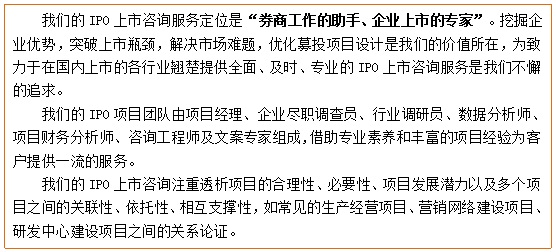 Huajing Zongheng has a very solid research foundation in fundraising project feasibility studies and can provide clients with high-quality services: 15.10 The necessity and rationality of significantly increasing investment in fixed assets, intangible assets, and R&D expenses (key point)

- Home
- About Us
- Products
- DC Resistance Tester
- High Current Generator
- Loop Resistance Tester
- Transformer Test Transformer
- Feature Comprehensive Tester
- Capacitance/Inductance Tester
- Transformer Capacity Characteristic Tester
- DC HV Generator
- Dielectric Loss Tester
- Triple Frequency Generator
- Switch Characteristic Tester
- Series Variable Frequency Resonance Test
- Insulation Resistance Tester
- Turns Ratio and Vector Group Tester
- Lightning Arrester Tester
- Cable Fault Tester
- Lightning Counter Calibrator
- Partial Discharge Tester
- Mining Stray Current Tester
- VLF Insulation Withstand Test
- Company News
- Industry Trends
- Messages
- Contact Us
☎
Service Hotline18952707000