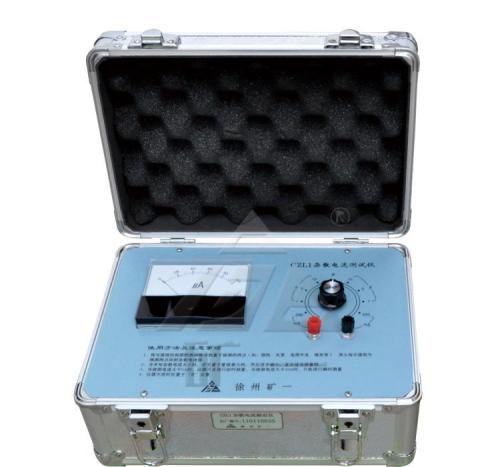
Mine Stray Current Tester
Darui Electric recommends:
I. Purpose
The FZY-3 mine stray current tester is a portable rectifier instrument with high sensitivity and multi-range protection circuits.Its features include: wide measurement range, with a total of twenty ranges, capable of measuring AC/DC stray voltage and stray current separately, requiring no internal power supply, and being safe and reliable. It is suitable for testing currents and voltages generated by steel rails, water pipes, cables, etc. in underground coal mines, preventing premature detonation of electric detonators and other combustion and explosion accidents caused by stray current discharge, minimizing fire sources in mines.
II. Performance
Instrument measurement range and accuracy class
|
Measurement Range
|
Measurement Accuracy
|
Remarks
|
|
Current Range
|
0-50mA-250mA
-1A-5A-10A
|
AC ±5%
DC ±2.5%
|
Before use, the pointer must be adjusted
to the zero position, i.e., zero adjustment
|
|
Voltage Range
|
0-0.2V-1V
-4V-20V-40V
|
III. Usage Methods and Precautions
1. Before measurement, screw the test lead connectors onto the two binding posts respectively, and adjust the meter pointer to the zero scale line.
2. Place the test leads connected to the binding posts on the two points to be measured (e.g., steel rail, water pipe, cable sheath, coal, earth, etc.). The two test points should be on different conductors, with a distance of about 2 meters. Normally, measure every 50-100 meters, or determine test points temporarily as needed. Set the range switch to the appropriate position, and the meter reading, after conversion, gives the corresponding current value.
3. During measurement, ensure good contact between the hard alloy tip of the measuring probe and the object under test. The instrument should be placed horizontally to ensure accurate readings.
4. When no AC stray current is measured at a location, also test for DC stray current, and vice versa.
5. When measuring stray voltage values, the corresponding ranges are: 50mA corresponds to 0.2V, 250mA corresponds to 1V, 1A corresponds to 4V, 5A corresponds to 20V, 10A corresponds to 40V. (i.e., current value multiplied by 4 gives the voltage value)
6. When the magnitude of stray current is unknown, first set to the maximum range, then gradually decrease until the appropriate measuring range.
7. When the measured current exceeds 5A, the instrument should only be used for short-time measurements; when the measured current exceeds 10A, the instrument should only be used for instantaneous measurements. This prevents large currents from burning out components and the instrument.
8. When measuring DC stray current, if the meter pointer deflects in the reverse direction, swap the test leads.
9. When the instrument is not in use, set it to the "OFF" position.
 Note: The above information and technical parameters are compiled and released by Yangzhou Darui Electric Co., Ltd.