In order to write an article about “Resonance Conditions: Application in Series Resonant Circuits”, it can be elaborated in detail from the following aspects:
Title
Resonance Conditions: Application in Series Resonant Circuits
Introduction
In electronics and power engineering, the resonance phenomenon is an important concept, especially in fields involving signal processing, communication, and power transmission. Series resonant circuits are highly regarded for their applications in high-frequency signal processing, power system testing, and radio communication. This article will delve into the basic principles, resonance conditions, and practical applications of series resonant circuits.
Basic Concepts of Series Resonant Circuits
A series resonant circuit is formed by connecting an inductor (L), a capacitor (C), and a resistor (R) in series. When the circuit is at a specific frequency, the inductive reactance (XL) equals the capacitive reactance (XC), and the circuit exhibits purely resistive characteristics, which is known as the series resonance state.
When , the circuit will reach the resonance state.
Characteristics of the Resonance State
Minimum Impedance: At the resonant frequency, the total impedance of the circuit is minimized, exhibiting almost purely resistive characteristics, i.e.,
Maximum Current: For a given voltage source, the current in the circuit will reach its maximum value at resonance.
Phase Alignment: Under resonance conditions, the voltage and current are in phase, meaning there is no phase difference between them.
Energy Exchange: Energy is exchanged between the inductor and capacitor, but externally, energy consumption occurs only on the resistor.
Applications of Series Resonant Circuits
Filter Design: Utilizing the characteristics of series resonant circuits, band-pass filters can be designed to allow signals within a specific frequency range to pass through.
Tuning Circuits: In radio receivers, the resonant frequency of the circuit is adjusted to select and receive signals of a specific frequency.
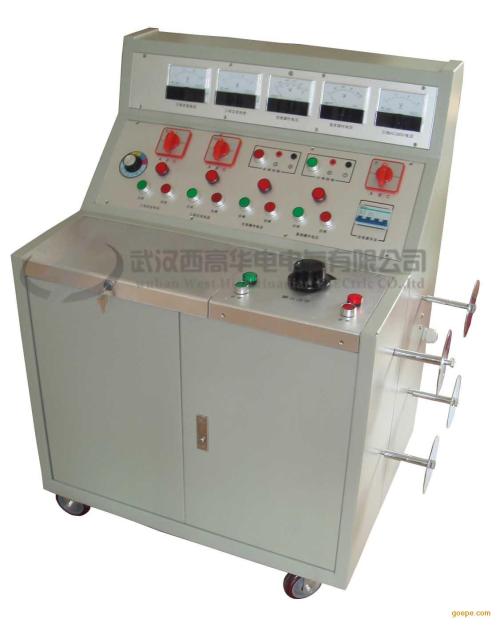
Power Testing: In high-voltage power equipment testing, series variable-frequency resonant testing can generate high voltages to test the insulation performance of equipment.
Induction Heating: Using the series resonance principle, high voltages can be generated at specific frequencies for induction heating of metal materials.
Practical Application Cases
Wireless Communication Systems: When designing antenna systems, circuit parameters are adjusted to make the antenna resonate at a specific frequency, thereby improving reception efficiency.
Power System Testing: In withstand voltage tests for power cables, series variable-frequency resonant devices are used to generate high voltages from a lower power supply voltage to test the cables.
Conclusion
Series resonant circuits, with their unique physical characteristics, play an important role in modern electronic engineering and power systems. By understanding and mastering the resonance conditions and their applications, engineers can design more efficient and precise electronic devices and power testing systems. With continuous technological advancement, series resonant circuits will continue to demonstrate their value in more fields.
This article provides a detailed introduction to the basic principles, resonance conditions, and applications of series resonant circuits in multiple fields, helping readers gain a deeper understanding of this concept and its practical significance.