
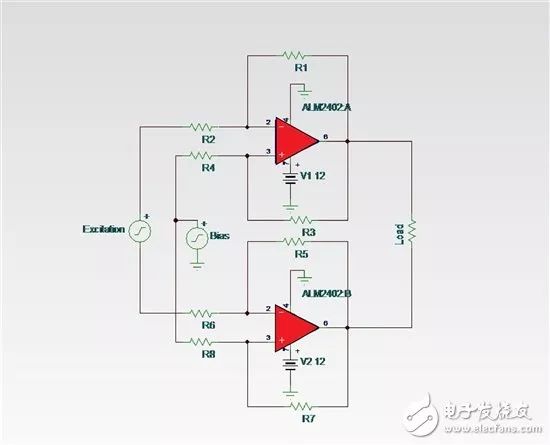
Usually, when defining a new device to meet stringent automotive standards, our team looks at other systems that require the same functionality, and we design devices that span all these applications. This is exactly what happened when our team developed the new ALM2402, a dual high-current operational amplifier (op amp) designed for automotive applications. When defining the ALM2402, we realized that many automotive and industrial systems require an op amp capable of driving high-current capacitive or inductive loads. In the past, designers were often required to use discrete components to meet this need.Transformer Turns Ratio Tester. To design a simple high-current amplifier with discrete components, you need an amplifier, bipolar junction transistors (BJTs), and diodes. Figure 1 shows such an example, commonly used in motor driver applications. This implementation can drive the excitation coil of a resolver (used to measure the rotation angle of a motor shaft). You can find amplifier designs (such as driving inductive loads) in many automotive and industrial applications. This typical solution poses challenges to designers in terms of circuit board space and output transistor biasing. Additionally, it increases the space challenges of discrete implementations. Without overcurrent protection, the system becomes "dumb." If there is no protection function, it will continue to burn out the power supply.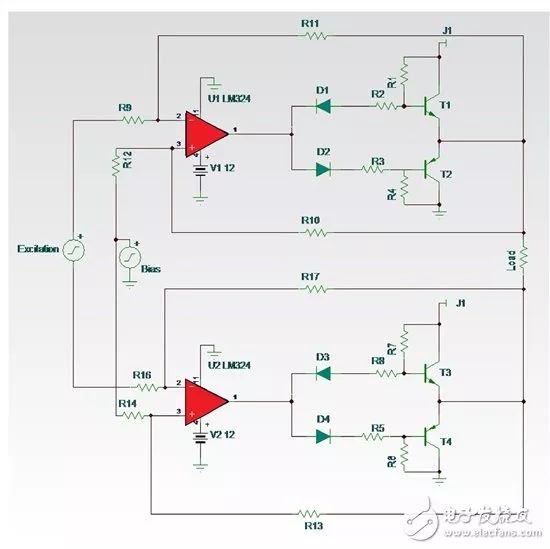 For comparison, let's look at the implementation shown in Figure 2 for driving the excitation line. Simple, right? Without the need for external transistor biasing, the ALM2402 can drive up to 400mA of current through each channel. This circuit is very small, housed in a 3mm × 3mm DRR package, allowing designers to minimize their overall solution size.
 In high-current drive applications, protection features are key requirements. The ALM2402 integrates multiple system protection features, and the device's flag pin has a convenient function with multiple uses. When an overtemperature event occurs, the flag pin goes low, allowing the user to design a feedback mechanism to shut down the system. These can also be externally pulled down on the flag pin to shut down the op amp, putting it into sleep mode and consuming very little current. This feature is very useful for battery applications where power consumption is critical. Disclaimer: The content is compiled from the internet, and the copyright belongs to the original author. If it involves copyright issues of the work, please contact us in time, thank you! Statement: This article is written by the author who is settled on the Sohu public platform. Except for Sohu's official account, Three-phase Capacitance Inductance Tester! The views only represent the author's own, and do not represent Sohu's position.

- Home
- About Us
- Products
- DC Resistance Tester
- High Current Generator
- Loop Resistance Tester
- Transformer Test Transformer
- Feature Comprehensive Tester
- Capacitance/Inductance Tester
- Transformer Capacity Characteristic Tester
- DC HV Generator
- Dielectric Loss Tester
- Triple Frequency Generator
- Switch Characteristic Tester
- Series Variable Frequency Resonance Test
- Insulation Resistance Tester
- Turns Ratio and Vector Group Tester
- Lightning Arrester Tester
- Cable Fault Tester
- Lightning Counter Calibrator
- Partial Discharge Tester
- Mining Stray Current Tester
- VLF Insulation Withstand Test
- Company News
- Industry Trends
- Messages
- Contact Us
☎
Service Hotline18952707000