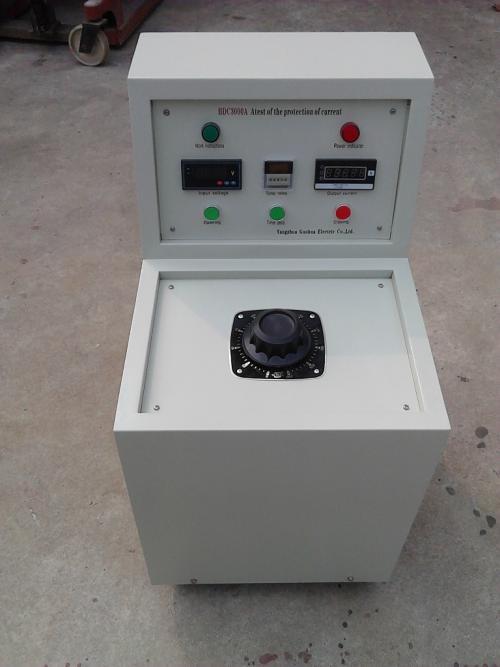
Frequency converters are divided into two major categories by structure: those with 20kW and above are console type, and those below 20kW are portable box type; they are composed of a controller and a filter. In the system, the main function of the frequency converter is to convert the fixed amplitude and frequency sinusoidal AC power of 380V or 220V at 50Hz into a sine wave with adjustable amplitude and frequency, and provide power to the entire equipment.
The frequency converter has reliable protection functions such as IGBT protection, overcurrent protection, overvoltage protection, discharge protection, and input protection, ensuring the safety of test personnel and test objects.
IGBT protection: When the IGBT current is too high or the temperature is too high, the CPU will stop working until the system returns to normal.
Overvoltage protection: When the test voltage exceeds the manually set protection voltage (which can be arbitrarily set according to different test voltage requirements), the controller automatically trips, the CPU stops working, and prompts that the system has experienced overvoltage protection.
Overcurrent protection: When the CPU detects that the bus operating current exceeds the IGBT operating current or the IGBT temperature is too high, the CPU will issue an overcurrent protection signal, the device stops working, and the system prompts overcurrent protection through the LCD screen.
Discharge protection: When the test object breaks down, short-circuits, or discharges, the CPU stops working and cuts off the main circuit.
Input protection and low-pass filter: Not only can it reduce the discharge or breakdown current in steady state, but also reduce the damage of transient instantaneous current, thereby ensuring the safety of equipment and personnel.
Measurement part: Test personnel can directly read the input voltage, current, current working frequency, output voltage and current of the frequency converter, and the resonant voltage signal applied to the test object from the control panel of the frequency converter.
3.2.2 Excitation transformer
The function of the excitation transformer is to step up the output voltage of the variable frequency power supply to a suitable test voltage, meeting the test voltage requirements of the reactor and load under a certain quality factor (the capacity of the excitation transformer is generally the same as that of the frequency converter). In order to meet the test requirements of test objects with different voltage levels and capacities, the high-voltage winding of the excitation transformer generally has multiple taps.
3.2.3 High-voltage reactor
The high-voltage reactor L is an important component of the resonant circuit. When the power supply frequency equals 1/(2π√LCx ), it resonates in series with the test object Cx; the performance of the reactor directly affects the Q value of the system.
3.2.4 High-voltage divider
The high-voltage divider is a high-voltage testing device, consisting of a high-voltage arm C1 and a low-voltage arm C2. The measurement signal is taken from the low-voltage arm C2 and serves as the high-voltage measurement and protection signal.
3.3 Factors determining system configuration parameters
The resonant voltage level and capacity of the system depend on the capacitance C of the test object, the test voltage U, and the test frequency f.
- For cross-linked polyethylene cables, the main factors determining the system configuration are: the voltage level of the cable, the cross-sectional area of the cable, the length of the test cable, and the required resonant frequency range of the cable.
- For GIS, the factors determining the system configuration are: the voltage level of the GIS, the number of intervals in the GIS and the capacitance C of each interval, and the allowable test frequency range of the GIS.
- For transformers, generators, and other equipment, the system configuration depends on the capacity of the test object, the test voltage, the equivalent capacitance C of the test object, the required resonant frequency, and the no-load loss of the test object.