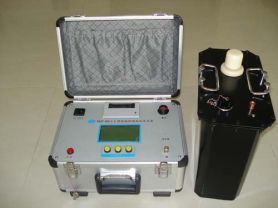

Partial discharge is a phenomenon that occurs in the insulation materials of high-voltage electrical equipment, which gradually deteriorates the performance of the insulation and may eventually lead to equipment failure. The ultrasonic partial discharge inspection instrument detects partial discharge by capturing the ultrasonic signals generated, which is crucial for preventing potential faults.
Working Principle
When partial discharge occurs inside the insulation of power equipment, it simultaneously generates ultrasonic signals (frequency greater than 20kHz). These ultrasonic signals propagate along the insulation medium, metal parts, or air to the equipment casing, and then spread to the surrounding air through the medium and gaps. The ultrasonic partial discharge inspection instrument detects the ultrasonic signals generated by partial discharge by placing ultrasonic sensors at gaps in the equipment casing, thereby determining the partial discharge condition of the power equipment.
Main Features
Portable Design: Lightweight and portable, suitable for on-site testing.
High Sensitivity: Equipped with high detection sensitivity, capable of capturing weak partial discharge signals.
Wide Applicability: Suitable for various high-voltage electrical equipment, such as transformers, instrument transformers, generators, surge arresters, bushings, GIS, capacitors, power cables, switches, etc.
Intelligent Analysis: Built-in intelligent analysis software that can automatically identify and classify partial discharge types.
Data Recording and Analysis: Capable of recording test data and providing data analysis functions to help users better understand test results.
User-Friendly Interface: Uses touch screen or button operation, simple and intuitive.
Multi-Channel Synchronous Detection: Can simultaneously introduce signals from multiple positions of the equipment, providing more comprehensive detection data.
Strong Anti-Interference Capability: Uses advanced anti-interference technology to ensure accurate detection results even in complex environments.
Multiple Sensor Configurations: Different types of sensors can be selected as needed, such as flexible sensors, contact ultrasonic sensors, high-frequency current transformers, etc.
Laser Positioning and Image Acquisition: Some advanced models are equipped with laser positioning and image acquisition functions, which can precisely indicate the specific location of partial discharge and record the on-site conditions.
Technical Parameters
Measurement Channels: Multi-channel synchronous detection.
Detection Frequency Range: Ultrasonic frequency is typically from 20kHz to several hundred kHz.
Power Supply: Usually battery-powered, supporting long-duration continuous operation.
Data Output: Data can be transferred to a computer via USB or other interfaces for further analysis.
Display Modes: Can display discharge waveform diagrams, time-domain diagrams, frequency spectrum diagrams, trend charts, etc.
Application Fields
Ultrasonic partial discharge inspection instruments are widely used in
Power Systems: Used for partial discharge detection in transformers, instrument transformers, high-voltage switches, and other equipment.
Manufacturing: Used for type tests and factory inspections of products such as power cables and zinc oxide surge arresters.
Research Institutions: Used for research and development testing of new materials and new products.
Operational Monitoring: Regular monitoring of high-voltage equipment in operation to prevent potential faults.
Usage Cases
Case 1: A power company used an ultrasonic partial discharge inspection instrument to regularly test transformers at its substation, successfully discovering a partial discharge problem inside one transformer and taking timely measures to avoid a major accident.
Case 2: A cable manufacturer installed an ultrasonic partial discharge inspection instrument on its production line to conduct partial discharge tests on cables about to leave the factory, effectively improving product quality.
Conclusion
The ultrasonic partial discharge inspection instrument plays an important role in the maintenance and management of high-voltage electrical equipment due to its efficient and accurate detection capability and multifunctionality. With technological advancements, the functions of such testing instruments will become more comprehensive, providing better guarantees for the safe operation of power systems.
The above content provides a basic overview of the ultrasonic partial discharge inspection instrument. It should be noted that different models and brands of ultrasonic partial discharge inspection instruments may have different features and usage methods. Before actual operation, please refer to the specific user manual and technical documentation.